Spur and helical gears both transmit power between parallel shafts, and from across the room they can look similar. The difference is in the teeth — and that difference decides which one belongs in your machine.
Spur gears: straight and simple
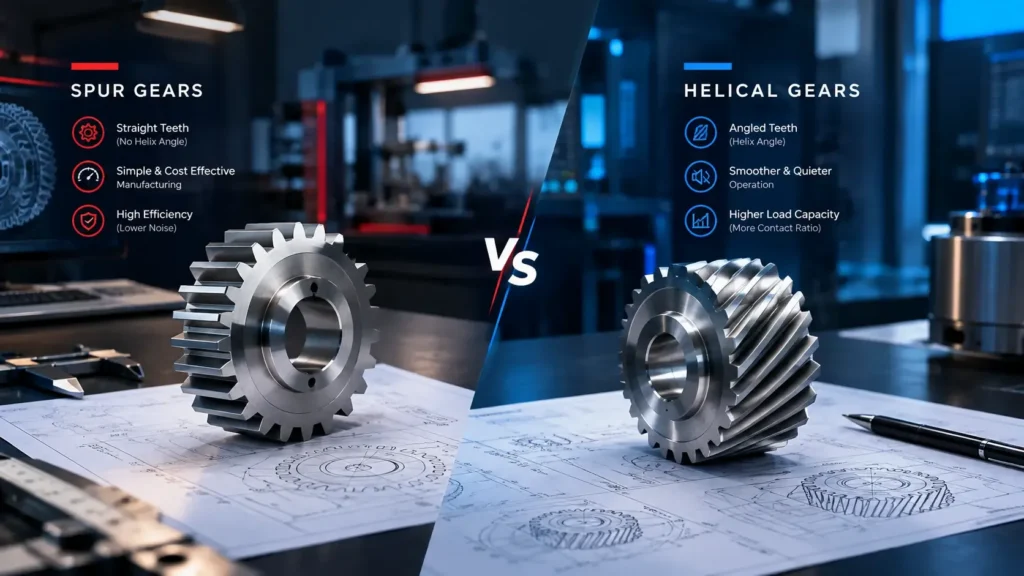
A spur gear’s teeth run straight across the face, parallel to the shaft. That makes them straightforward to manufacture, easy to inspect, and efficient. The trade-off is noise: each tooth engages all at once, so spur gears can whine at speed. They’re a great fit where cost, simplicity and efficiency matter more than quiet running.
- Simple to produce and inspect
- High efficiency, no axial thrust load
- Can be noisier at high speed
- Great default for many general-purpose drives
Helical gears: angled and smooth
A helical gear’s teeth are cut at an angle to the shaft. Because each tooth engages gradually rather than all at once, helical gears run more smoothly and quietly and can carry more load for a given size. The angle does introduce an axial thrust force the bearings have to handle, and the geometry is a little more involved to make — but for higher speeds and quieter operation, the trade is often worth it.
- Smoother, quieter engagement
- Higher load capacity for the same size
- Produces an axial thrust load the design must account for
- Preferred where noise and speed matter
How to choose
If the drive is low-to-moderate speed and you want the simplest, most economical solution, spur gears are usually the answer. If it runs fast, needs to be quiet, or carries heavy loads in a compact space, helical gears earn their keep. In practice the application decides — and if you’re not sure, describe what the gear does and we’ll point you to the right one.
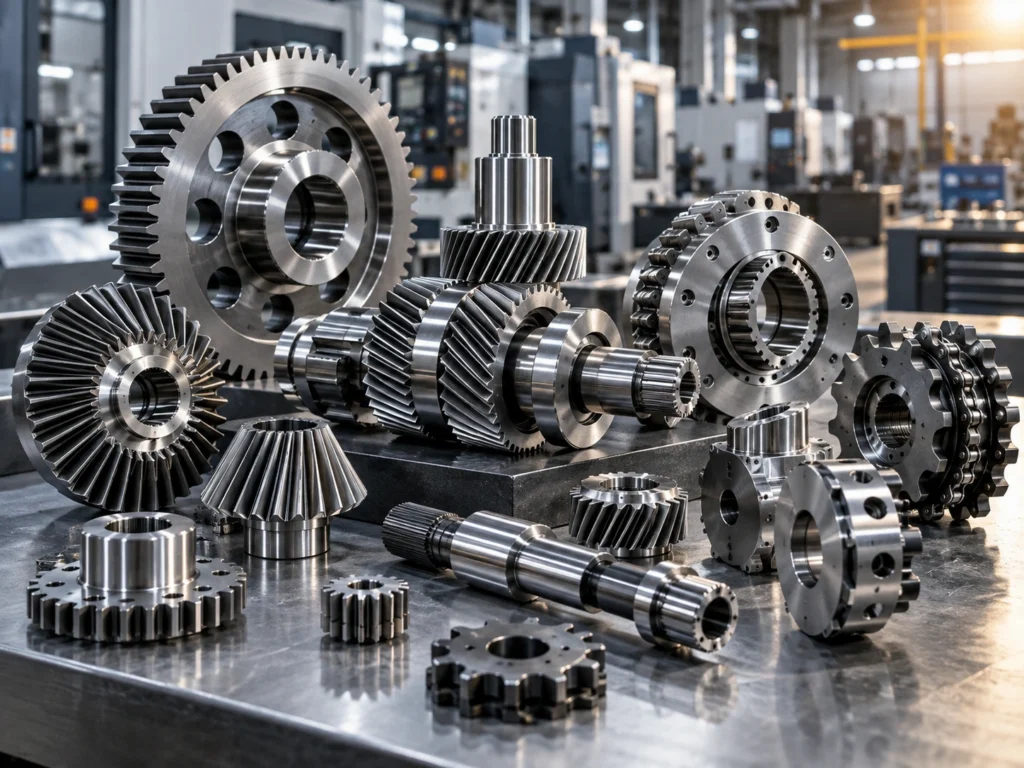
We cut both spur and helical gears to your print, along with bevel, worm, splines, racks and sprockets. Send the drawing or the application and we’ll quote it.