The handful of callouts a gear shop needs to quote your part accurately — and how to spot what’s missing before it slows your quote down.
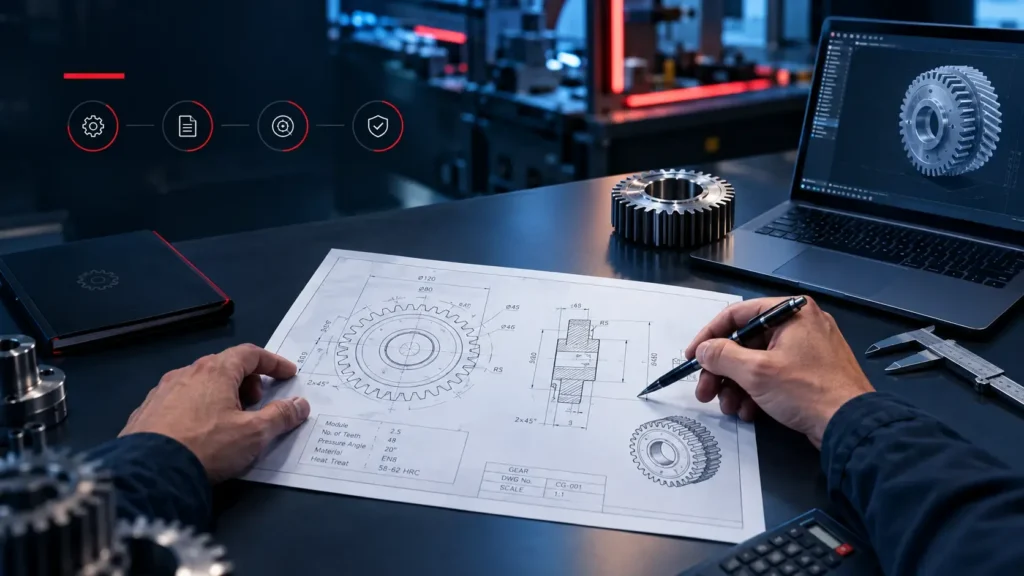
A gear quote is only as good as the drawing it’s based on. When a print is complete, a shop can price your part quickly and confidently. When key data is missing, the quote either stalls while everyone emails back and forth, or it comes back padded to cover the unknowns. Here’s what a gear manufacturer is actually looking for when your RFQ lands.
The gear-tooth data
This is the heart of the part. For most gears, a shop needs the number of teeth, the diametral pitch (or module), the pressure angle, and the pitch diameter. Together these define the tooth form. If the gear meshes with a mating part you already have, say so — the shop can work back from it.
- Number of teeth
- Diametral pitch or module
- Pressure angle (commonly 14.5° or 20°)
- Pitch diameter and outside diameter
- For helical gears: helix angle and hand (right or left)
Quality and inspection
If your application needs a particular AGMA quality class, put it on the print. If it doesn’t, that’s fine too — but say what the gear does, because a quiet-running instrument drive and a slow-turning conveyor sprocket have very different quality needs. The more the shop knows about the function, the better it can match the process to it.
Material and secondary operations
Name the material, or describe the environment and load if you’re open to a recommendation. Then flag anything that happens after cutting: heat treat, grinding, plating or a specific surface finish. These drive both the routing and the price, and they’re the details most often left off a first-draft print.
No formal drawing? A sample part or even a clear sketch with the mating dimensions is often enough to get started. We reverse-engineer parts from a sample regularly.